
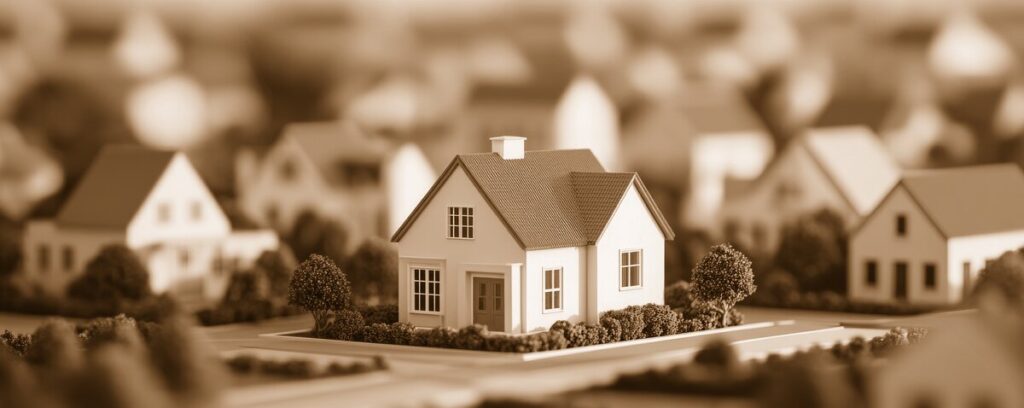
A Neighborhood with More Than One Name
In northern New Rochelle, just west of the Town of Mamaroneck line, there is a leafy residential area known today as Larchmont Woods—and, in older records, as The Woods of Larchmont. The neighborhood is generally associated with Maywood Road, Wildwood Road, Mulberry Lane, Lotus Road, Linwood Road, Beech Road, Poplar Road, Springdale Road, Ridge Road, and Highpoint Road, along with portions of Woodlawn Avenue, Forest Avenue, Kingsbury Road, and Mountain Avenue. ([everything.explained.today](https://everything.explained.today/List_of_neighborhoods_in_New_Rochelle%2C_New_York/?utm_source=openai))
The name can be confusing to newcomers. The neighborhood is located within the City of New Rochelle, not the Village of Larchmont. Yet its landscape, postal history, nearby town boundary, and connection to the broader Larchmont area all helped give it a Larchmont identity. “The Woods” was a practical description as much as a promotional one: this was a wooded upland landscape being gradually transformed into a residential suburb.
Even today, the name feels appropriate. Mature trees shade the streets, houses sit back from the road, and the neighborhood retains a sense of separation from the busier commercial corridors nearby.
Before the Houses: Farms, Woods, and Country Roads
Long before subdivision maps and paved streets, this part of Westchester was a rural landscape of forests, fields, stone walls, and scattered farmsteads. The land belonged to the larger colonial and agricultural history of New Rochelle, Larchmont, and Mamaroneck, communities shaped by early land purchases, farming, mills, and maritime trade.
The surrounding region began changing rapidly during the nineteenth century. New York City’s expanding population and improved transportation encouraged wealthy families and middle-class commuters to seek homes outside Manhattan. Larchmont, Mamaroneck, and New Rochelle gradually evolved from rural and resort communities into connected suburban districts. Larchmont itself transitioned especially quickly after the arrival of improved transportation and the rise of automobile commuting. ([en.wikipedia.org](https://en.wikipedia.org/wiki/Larchmont%2C_New_York?utm_source=openai))
The future Woods of Larchmont occupied an appealing position. It was close enough to rail and major roads for access to New York City, yet far enough from the waterfront and downtown to offer privacy, fresh air, and a country-like setting.
The Origin of “The Woods of Larchmont”
The phrase “Woods of Larchmont” appears in residential and real-estate records from the early twentieth century. A surviving archival inventory identifies the New Rochelle Association of the Woods of Larchmont, active from 1925 to 1945. The association was organized as a residential community group, helping residents improve local infrastructure and coordinate neighborhood concerns. ([nyheritage.contentdm.oclc.org](https://nyheritage.contentdm.oclc.org/digital/api/collection/p16694coll52/id/1738/download?utm_source=openai))
That organization offers an important clue to the neighborhood’s development. The Woods was not simply a collection of individually built houses. It was also a planned community whose residents shared responsibility for roads, property standards, drainage, and the everyday work of creating a stable suburban environment.
In many Westchester neighborhoods, names such as “woods,” “park,” “knolls,” and “heights” were used by developers to express a particular ideal: a gracious country setting within commuting distance of Manhattan. The Woods of Larchmont followed that pattern, but the surrounding natural character was genuine. The streets were laid through rolling, wooded terrain rather than across a flat urban grid.
Suburban Growth in the 1920s and 1930s
The most important period of physical growth came during the 1920s and early 1930s. New Rochelle was expanding northward, and nearby communities were being subdivided into attractive residential enclaves. Developments such as Beechmont Woods, Forest Knolls, and Larchmont Woods reflected the same broad suburban movement. Beechmont, for example, expanded significantly in the early 1920s, while Forest Knolls and Larchmont Woods developed nearby as part of the northern city’s growing residential belt. ([en.wikipedia.org](https://en.wikipedia.org/wiki/Beechmont%2C_New_York?utm_source=openai))
Homes in the Woods generally reflected the popular architecture of the era:
- Tudor Revival houses with steep roofs, brick façades, and prominent chimneys
- Colonial Revival homes with symmetrical fronts and traditional detailing
- Shingled and stone houses designed to blend with the wooded setting
- Comfortable postwar residences expanded or remodeled by later generations
The streets themselves were part of the attraction. Maywood Road, Wildwood Road, and Springdale Road have the kind of names that suggest the neighborhood’s original marketing language, while Beech Road and Poplar Road evoke the trees and natural features that helped define the area.
Streetscapes and Nearby Landmarks
The Woods of Larchmont is primarily a residential neighborhood, so its historic character is found less in one famous building than in the cumulative effect of its streets and houses. The mature canopy, varied setbacks, winding roads, stonework, and surviving early homes create a neighborhood landscape that still communicates its suburban origins.
Forest Avenue has long served as one of the area’s principal approaches, connecting the neighborhood with other northern New Rochelle communities and with Larchmont. Mountain Avenue and Woodlawn Avenue provide additional links toward Scarsdale, Mamaroneck, and the interior sections of New Rochelle.
The neighborhood also benefits from its proximity to several important open spaces. Ward Acres Nature Preserve, with its wooded trails, meadows, old stone walls, historic horse-related buildings, and remnants of earlier estates, provides a vivid reminder of the region’s rural past. Twin Lakes/Nature Study Woods offers another nearby landscape of wetlands, trails, and preserved woodland. These places help explain why northern New Rochelle still feels greener and more spacious than many other parts of the city.
Institutions such as Iona University, the New Rochelle Public Library, and the Huguenot and New Rochelle Historical Association are also part of the broader cultural setting. While not all are located directly within Larchmont Woods, they connect the neighborhood to the educational and historical life of the city.
The Postwar Years and Changing Households
After World War II, the Woods of Larchmont became part of New Rochelle’s established suburban fabric. Families who had arrived during the first building boom often stayed for decades. Houses were enlarged, kitchens modernized, and garages adapted as automobile ownership became essential to daily life.
The postwar era also brought changes in schooling, commuting, and neighborhood life. Forest Avenue and the surrounding roads became more important as automobile routes, while Metro-North’s New Haven Line remained a vital connection for commuters traveling toward New York City. The neighborhood’s appeal rested on a balance that still matters today: quiet residential streets combined with access to transportation, schools, shopping, parks, and neighboring villages.
Over time, the community became more architecturally varied. Some original homes remain remarkably intact, while others have undergone additions or complete renovations. A few older properties have disappeared, replaced by newer construction designed for contemporary family life. Yet the scale of the neighborhood—detached houses, generous trees, and low-density streets—has remained remarkably consistent.
A Living Heritage
The heritage of The Woods of Larchmont is not limited to a founding date or a list of notable residents. It is found in the way the neighborhood still works: neighbors walking beneath old trees, children growing up on quiet streets, families tending gardens, and residents caring about the appearance and future of the community.
Its history is also visible in the name itself. “The Woods of Larchmont” preserves the memory of a time when developers and residents saw the area as a wooded extension of the Larchmont country-suburban ideal. “Larchmont Woods” is the shorter modern form, but both names describe the same enduring character.
For longtime New Rochelle residents, that character is what makes the neighborhood special. The Woods feels settled without feeling frozen, historic without being formal, and connected to the city while retaining a distinctly local identity. Its story is the story of northern Westchester suburbanization: farms becoming roads, roads becoming neighborhoods, and neighborhoods becoming cherished places that carry their past quietly into the future.